
עברית · English · العربية · Türkçe · Ελληνικά
Quarter tones on guitar and bouzouki: from a rubber band to electronics
Why it is a problem
Eastern and Mediterranean music is largely built on maqamat, and maqamat such as Bayati, Rast and Sikah use quarter tones: intervals that sit between the frets. Instruments such as the oud and the violin have no frets and can play any pitch, but on a guitar or bouzouki every fret is a semitone.
On a guitar with a 650 mm scale length, a quarter tone above the open string is about 18.5 mm from the nut, and the first fret is about 36.5 mm. The quarter tone falls almost halfway, but not exactly, so pressing midway between frets does not give a clean note.
From a rubber band to a pin
To play authentic oriental ornaments, players looked for creative solutions. The story goes that one of the first guitarists in Middle Eastern music, Moshe Ben Mush, wrapped a rubber band around the neck between the frets. The band made a temporary pressure point that changed the vibrating length of the string and gave a quarter tone.
The story continues that the guitarist Yehuda Keisar upgraded the idea: instead of a rubber band he tied a pin, or a piece of stiff wire, around the neck exactly midway between two frets. The pin works as a rigid, accurate floating fret that gives a clean quarter tone with a light press.
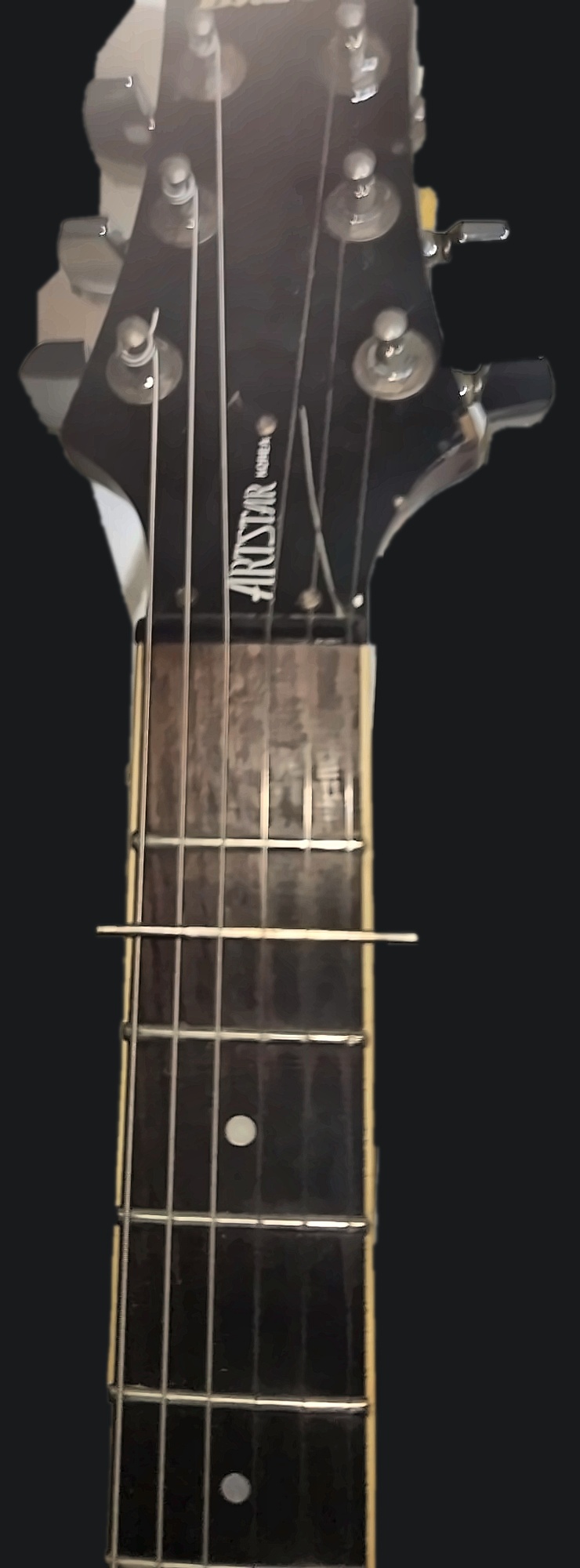
The pin is the traditional solution today: cheap, fully reversible, and movable. The drawbacks are that it takes up room, is hard to change while playing, and runs across all the strings.
Other ways
- String bending: fine finger control to bend the string by exactly a quarter tone rather than a semitone.
- Custom frets: modern bouzoukis and dedicated guitars have short fixed frets added at strategic places, for example between the first and second frets.
- Fretless instruments: remove all the frets for smooth quarter tones, but you need a very accurate ear.
- Removable fretlets: small frets in a channel under the string that can be moved or taken out.
The electronic solution: Quartback
In recent years an electronic solution appeared: Quartback, a note shifter that connects to an electric guitar or any electric melodic instrument and gives quarter tones in real time. According to the maker's site, the technology is patented and the conversion feels latency-free.
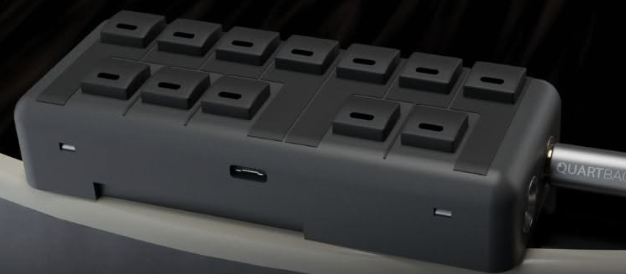
The advantage: you do not touch the neck or make any permanent change to the instrument, and you can switch quickly between Western playing and maqam playing, even in the middle of a gig or a studio session.
How to choose
- Want to try cheaply: a pin or a rubber band.
- Play by ear: string bending or a fretless instrument.
- Perform and switch between Western and maqam: an electronic solution.
- Want a dedicated permanent instrument: quarter-tone frets from a luthier.
On this site, quarter tones are marked in yellow on the fretboard, so you can see exactly where to place a pin or where the quarter tone falls.
Try it on the site
More articles
- Quarter tones: what they are and how to play them on guitar
- Maqam Rast for beginners: notes, structure and practice
- Tetrachordo or trichordo bouzouki: what is the difference